please help me
Attention...................................Attention

who has read BELOVED novel by Toni morrison
yesterday i search alot from this bookshop to that to find this novel but i could not find.can you help me from where i could buy it?
Attention...................................Attention
who has read BELOVED novel by Toni morrison
yesterday i search alot from this bookshop to that to find this novel but i could not find.can you help me from where i could buy it?

English - I love you
Afrikaans - Ek het jou lief
Albanian - Te dua
Arabic - Ana behibak (to male)
Arabic - Ana behibek (to female)
Armenian - Yes kez sirumen
Bambara - M'bi fe
Bangla - Aamee tuma ke bhalo aashi
Belarusian - Ya tabe kahayu
Bisaya - Nahigugma ako kanimo
Bulgarian - Obicham te
Cambodian - Soro lahn nhee ah
Cantonese Chinese - Ngo oiy ney a
Catalan - T'estimo
Cheyenne - Ne mohotatse
Chichewa - Ndimakukonda
Corsican - Ti tengu caru (to male)
Creol - Mi aime jou
Croatian - Volim te
Czech - Miluji te
Danish - Jeg Elsker Dig
Dutch - Ik hou van jou
Esperanto - Mi amas vin
Estonian - Ma armastan sind
Ethiopian - Afgreki'
Faroese - Eg elski teg
Farsi - Doset daram
Filipino - Mahal kita
Finnish - Mina rakastan sinua
French - Je t'aime, Je t'adore
Gaelic - Ta gra agam ort
Georgian - Mikvarhar
German - Ich liebe dich
Greek - S'agapo
Gujarati - Hoo thunay prem karoo choo
Hiligaynon - Palangga ko ikaw
Hawaiian - Aloha wau ia oi
Hebrew - Ani ohev otah (to female)
Hebrew - Ani ohev et otha (to male)
Hiligaynon - Guina higugma ko ikaw
Hindi - Hum Tumhe Pyar Karte hae
Hmong - Kuv hlub koj
Hopi - Nu' umi unangwa'ta
Hungarian - Szeretlek
Icelandic - Eg elska tig
Ilonggo - Palangga ko ikaw
Indonesian - Saya cinta padamu
Inuit - Negligevapse
Irish - Taim i' ngra leat
Italian - Ti amo
Japanese - Aishiteru
Kannada - Naanu ninna preetisuttene
Kapampangan - Kaluguran daka
Kiswahili - Nakupenda
Konkani - Tu magel moga cho
Korean - Sarang Heyo
Latin - Te amo
Latvian - Es tevi miilu
Lebanese - Bahibak
Lithuanian - Tave myliu
Malay - Saya cintakan mu / Aku cinta padamu
Malayalam - Njan Ninne Premikunnu
Mandarin Chinese - Wo ai ni
Marathi - Me tula prem karto
Mohawk - Kanbhik
Moroccan - Ana moajaba bik
Nahuatl - Ni mits neki
Navaho - Ayor anosh'ni
Norwegian - Jeg Elsker Deg
Pandacan - Syota na kita!!
Pangasinan - Inaru Taka
Papiamento - Mi ta stimabo
Persian - Doo-set daaram
Pig Latin - Iay ovlay ouyay
Polish - Kocham Ciebie
Portuguese - Eu te amo
Romanian - Te ubesk
Russian - Ya tebya liubliu
Scot Gaelic - Tha gra\dh agam ort
Serbian - Volim te
Setswana - Ke a go rata
Sign Language - ,\,,/ (represents position of fingers when signing'I Love You')
Sindhi - Maa tokhe pyar kendo ahyan
Sioux - Techihhila
Slovak - Lu`bim ta
Slovenian - Ljubim te
Spanish - Te quiero / Te amo
Swahili - Ninapenda wewe
Swedish - Jag alskar dig
Swiss-German - Ich lieb Di
Tagalog - Mahal kita
Taiwanese - Wa ga ei li
Tahitian - Ua Here Vau Ia Oe
Tamil - Nan unnai kathalikaraen
Telugu - Nenu ninnu premistunnanu
Thai - Chan rak khun (to male)
Thai - Phom rak khun (to female)
Turkish - Seni Seviyorum
Ukrainian - Ya tebe kahayu
Urdu - mai aap say pyaar karta hoo
Vietnamese - Anh ye^u em (to female)
Vietnamese - Em ye^u anh (to male)
Welsh - 'Rwy'n dy garu
Yiddish - Ikh hob dikh
Yoruba - Mo ni fe
please give me the name of your weblog and your E-mail so that we could have coaperation with each other.
thx for visiting my weblog.
John Donne, whose poetic reputation languished before he was rediscovered in the early part of the twentieth century, is remembered today as the leading exponent of a style of verse known as “metaphysical poetry,” which flourished in the late sixteenth and early seventeenth centuries. (Other great metaphysical poets include Andrew Marvell, Robert Herrick, and George Herbert.) Metaphysical poetry typically employs unusual verse forms, complex figures of speech applied to elaborate and surprising metaphorical conceits, and learned themes discussed according to eccentric and unexpected chains of reasoning. Donne’s poetry exhibits each of these characteristics. His jarring, unusual meters; his proclivity for abstract puns and double entendres; his often bizarre metaphors (in one poem he compares love to a carnivorous fish; in another he pleads with God to make him pure by raping him); and his process of oblique reasoning are all characteristic traits of the metaphysicals, unified in Donne as in no other poet.
Donne is valuable not simply as a representative writer but also as a highly unique one. He was a man of contradictions: As a minister in the Anglican Church, Donne possessed a deep spirituality that informed his writing throughout his life; but as a man, Donne possessed a carnal lust for life, sensation, and experience. He is both a great religious poet and a great erotic poet, and perhaps no other writer (with the possible exception of Herbert) strove as hard to unify and express such incongruous, mutually discordant passions. In his best poems, Donne mixes the discourses of the physical and the spiritual; over the course of his career, Donne gave sublime expression to both realms.
His conflicting proclivities often cause Donne to contradict himself. (For example, in one poem he writes, “Death be not proud, though some have called thee / Mighty and dreadful, for thou art not so.” Yet in another, he writes, “Death I recant, and say, unsaid by me / Whate’er hath slipped, that might diminish thee.”) However, his contradictions are representative of the powerful contrary forces at work in his poetry and in his soul, rather than of sloppy thinking or inconsistency. Donne, who lived a generation after Shakespeare, took advantage of his divided nature to become the greatest metaphysical poet of the seventeenth century; among the poets of inner conflict, he is one of the greatest of all time
L.y.i.n.g in bed with his lover, the speaker chides the rising sun, calling it a “busy old fool,” and asking why it must bother them through windows and curtains. Love is not subject to season or to time, he says, and he admonishes the sun—the “Saucy pedantic wretch”—to go and bother late schoolboys and sour apprentices, to tell the court-huntsmen that the King will ride, and to call the country ants to their harvesting.
Why should the sun think that his beams are strong? The speaker says that he could eclipse them simply by closing his eyes, except that he does not want to lose sight of his beloved for even an instant. He asks the sun—if the sun’s eyes have not been blinded by his lover’s eyes—to tell him by late tomorrow whether the treasures of India are in the same place they occupied yesterday or if they are now in bed with the speaker. He says that if the sun asks about the kings he shined on yesterday, he will learn that they all lie in bed with the speaker.
The speaker explains this claim by saying that his beloved is like every country in the world, and he is like every king; nothing else is real. Princes simply play at having countries; compared to what he has, all honor is mimicry and all wealth is alchemy. The sun, the speaker says, is half as happy as he and his lover are, for the fact that the world is contracted into their bed makes the sun’s job much easier—in its old age, it desires ease, and now all it has to do is shine on their bed and it shines on the whole world. “This bed thy centre the speaker tells the sun, “these walls, thy sphere is
 HI dear friends.unfortunately your guess was wrong.
 .
.
the picture in the last post belongs to my  favourite poet
.
.
.
.
 JOHN DONNE
he has many songs and sonnets,among them you can see Sun rising-Good morrow-The flea-The canonization-A validiction of his book-Love's growth....
for more information of his works click here
 http://www.luminarium.org/sevenlit/donne/donnebib.htm
now it is time to read one of his best work that is best for me too and then for more understanding i put a summary and analysis of it
 SUN RISING
BUSY old fool, unruly Sun,
Why dost thou thus,
Through windows, and through curtains, call on us ?
Must to thy motions lovers' seasons run ?
Saucy pedantic wretch, go chide
Late school-boys and sour prentices,
Go tell court-huntsmen that the king will ride,
Call country ants to harvest offices ;
Love, all alike, no season knows nor clime,
Nor hours, days, months, which are the rags of time.
Thy beams so reverend, and strong
Why shouldst thou think ?
I could eclipse and cloud them with a wink,
But that I would not lose her sight so long.
If her eyes have not blinded thine,
Look, and to-morrow late tell me,
Whether both th' Indias of spice and mine
Be where thou left'st them, or lie here with me.
Ask for those kings whom thou saw'st yesterday,
And thou shalt hear, "All here in one bed lay."
She's all states, and all princes I ;
Nothing else is ;
Princes do but play us ; compared to this,
All honour's mimic, all wealth alchemy.
Thou, Sun, art half as happy as we,
In that the world's contracted thus ;
Thine age asks ease, and since thy duties be
To warm the world, that's done in warming us.
Shine here to us, and thou art everywhere ;
This bed thy center is, these walls thy sphere.
GUESS THIS PICTURE BELONGES TO  WHOM
WHOM IN THE NEXT POST I WILL GIVE YOU SOME INFORMATION ABOUT HIM TO YOU AND ANALYSE WITH EACH OTHERS ONE OF HIS MOST FAMOUS WORK.I AM WAITING FOR YOUR COMMENTS
|
|
| An Easy Way To Begin
Poetry is the dramatization of experience in metrical language. To study or analyze poetry, one must consider many elements. A good way to start is by reading the poem silently. Then read the poem a second (third, fourth) time aloud. Reading the poem aloud makes its meaning clearer and you will hear the various poetic sound devices such as alliteration, rhyme, rhythm, etc. Then try writing down a brief summary to make sure that you are understanding the poem. Remember to read sentence by sentence not line by line. Questions To Answer Before Writing
Writing Your Paper The actual writing of the paper is probably the easiest task because you have already identified everything that needs to be covered. You may wish to cover all the important items in your own order, however, the order listed above does work well. Most likely you will not be able to simply write a few lines for each device, rather you must group these devices together. A proper order of paragraphs may flow like this:
Remember, when you are writing this paper you should use direct quotes wherever you can, you should vary your sentence structure, and all rules of grammar still apply. |

۱ . کنجکاوی را دنبال کنید
“من هیچ استعداد خاصی ندارم .فقط عاشق کنجکاوی هستم “
چگونه کنجکاوی خودتان را تحریک می کنید ؟ من کنجکاو هستم. مثلا پیدا کردن علت اینکه چگونه یک شخص موفق است و شخص دیگری شکست می خورد .به همین دلیل است که من سال ها وقت صرف مطالعه موفقیت کرده ام . شما بیشتر در چه مورد کنجکاو هستید ؟
پیگیری کنجکاوی شما رازی است برای رسیدن به موفقیت.
۲ .پشتکار گرانبها است
“من هوش خوبی ندارم، فقط روی مشکلات زمان زیادی میگذارم”
تمام ارزش تمبر پستی توانایی آن به چسبیدن به چیزی است تا زمانی که آن را برساند.مانند تمبر پستی باشید ؛ مسابقه ای که شروع کرده اید را به پایان برسانید .
با پشتکار می توانید به مقصد برسید.
۳ .تمرکز بر حال
“مردی که بتواند در حالی که دختر زیبایی را می بوسد با ایمنی رانندگی کند ، به بوسه اهمیتی را که سزاوار آن هست نمیدهد “
پدرم به من می گفت نمی توانی در یک زمان بر ۲ اسب سوار شوی .من دوست داشتم بگویم تو می توانی هر چیزی را انجام بدهی اما نه همه چیز .یاد بگیرید که در حال باشید.تمام حواستان را بدهید به کاری که در حال حاضر انجام میدهید.
انرژی متمرکز، توان افراد است، و این تفاوت پیروزی و شکست است .
۴ .تخیل قدرتمند است .
“تخیل همه چیز است .می تواند باعث جذاب شدن زندگی شود .تخیلی به مراتب از دانش مهم تر است “
آیا شما از تخیلات روزانه استفاده می کنید ؟ تخیل از دانش مهم تر است ! تخیل شما پیش نمایش آینده شما است .نشانه واقعی هوش دانش نیست ، تخیل است.
آیا شما هر روز ماهیچه های تخیلتان را تمرین می دهید ؟اجازه ندهید چیزهای قدرتمندی مثل تخیل به حالت سکون دربیایند.
۵ .اشتباه کردن
“کسی که هیچ وقت اشتباه نمی کند هیچ وقت هم چیز جدید یاد نمیگیرد “
هرگز از اشتباه کردن نترسید .اشتباه شکست نیست .اشتباهات شما را بهتر،زیرک تر و سریع تر می کنند، اگر شما از آنها استفاده مناسب کنید . قدرتی که منجر به اشتباه می شود را کشف کنید .
من این را قبل گفته ام ،و اکنون هم می گویم ، اگر می خواهید به موفقیت برسید اشتباهاتی که مرتکب می شوید را ۳ برابر کنید .
۶ .زندگی در لحظه
“من هیچ موقع در مورد آینده فکر نمی کنم ،خودش بزودی خواهد آمد”
تنها راه درست آینده شما این است که در “همین لحظه ” باشید .
شما زمان حال را با دیروز یا فردا نمی توانید عوض کنید .،بنابراین این از اهمیت فوق العاده برخوردار است، که شما تمام تلاش خود را به زمان جاری اختصاص دارید .این تنها زمانی است که اهمیت دارد ، این تنها زمانی است که وجود دارد .
۷ .خلق ارزش
“سعی نکنید موفق شوید ، بلکه سعی کنید با ارزش شوید “
وقت خود را به تلاش برای موفق شدن هدر ندهید،وقت خود را صرف ایجاد ارزش کنید .اگر شما با ارزش باشید ،موفقیت را جذب می کنید
استعدادها و موهبت هایی که دارید را کشف کنید ، بیاموزید چگونه آن استعدادها و موهبت های الهی را در راهی استفاده کنید که برای دیگران مفید باشد .
تلاش کنید تا با ارزش شوید و موفقیت شما را تعقیب خواهد کرد .
۸ .انتظار نتایج متفاوت نداشته باشید.
“دیوانگی : انجام کاری دوباره و دوباره و انتظار نتایج متفاوت داشتن “
شما نمی توانید کاری را هر روز انجام دهید و انتظار نتایج متفاوت داشته باشید ،به عبارت دیگر، نمی توانید همیشه کار یکسانی (کارهای روزمره) را انجام دهید، و انتظار داشته باشید متفاوت به نظر برسید.برای اینکه زندگی تان تغیر کند، باید خودتان را تا سر حد تغییر افکار و اعمالتان متفاوت کنید، که متعاقبا زندگی تان تغییر خواهد کرد.
۹ .دانش از تجربه می آید .
“اطلاعات به معنای دانش نیست . تنها منبع دانش تجربه است “
دانش از تجربه می آید . شما می توانید درباره انجام یک کار بحث کنید ، اما این بحث فقط دانش فلسفی از این کار به شما می دهد .شما باید این کار را تجربه کنید تا از آن آگاهی پیدا کنید .تکلیف چیست ؟ دنبال کسب تجربه باشید !
وقت خودتون رو صرف یادگرفتن اطلاعات اضافی نکنید .دست بکار شوید و دنبال کسب تجربه باشید .
۱۰ .اول قوانین را یاد بگیرید بعد بهتر بازی کنید.
“اگر شما قوانین بازی را یاد بگیرید از هر کس دیگر بهتر بازی خواهید کرد”
۲ گام هست که شما باید انجام بدهید .اولین گام این است که شما باید قوانین بازی که می کنید را یاد بگیرید ،این یک امر حیاتی است.گام دوم این که شما باید بازی را از هر فرد دیگری بهتر انجام بدهید .اگر شما بتوانید این ۲ گام را انجام دهید موفقیت از آن شما می شود
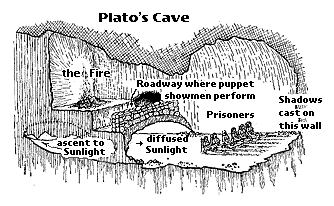
From Great Dialogues of Plato: Complete Texts of the Republic, Apology, Crito Phaido, Ion, and Meno, Vol. 1. (Warmington and Rouse, eds.) New York, Signet Classics: 1999. p. 316.
He thinks he is talking about a book, but he is really talking about a shadow. But he uses the word “book.” What does that refer to?
“And if they could talk to one another, don’t you think they’d suppose that the names they used applied to the things they see passing before them?”
If a prisoner says “That’s a book” he thinks that the word “book” refers to the very thing he is looking at. But he would be wrong. He’s only looking at a shadow. The real referent of the word “book” he cannot see. To see it, he would have to turn his head around.
Likewise, we may acquire concepts by our perceptual experience of physical objects. But we would be mistaken if we thought that the concepts that we grasp were on the same level as the things we perceive.